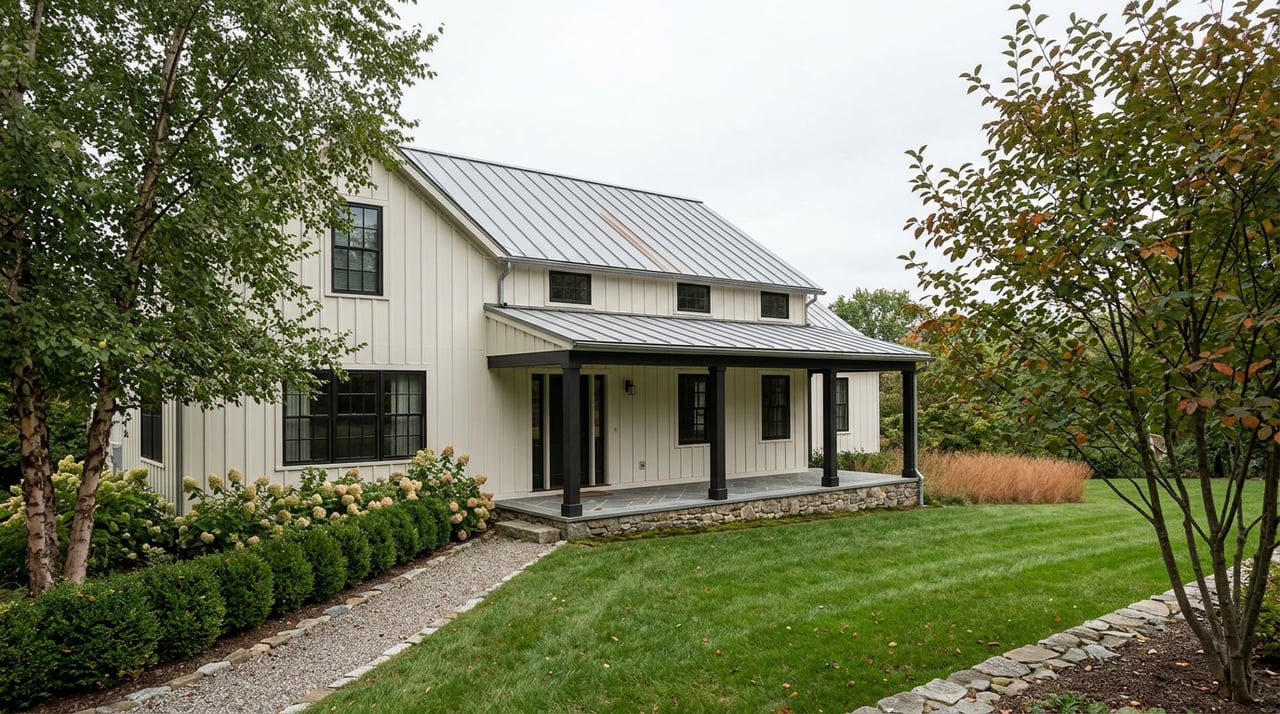
Buying Lakefront Near Ludington? The Erosion Permit Rules Didn't Reset When the Lake Did
September 24, 2026
September 24, 2026
Stand on a bluff overlook near Buttersville this September and Lake Michigan looks almost sleepy. Small waves, a flat horizon, none of the churn that made national news a few years back. That calm isn't your imagination. After climbing to record highs in 2019 and 2020, lake levels have fallen steadily, and by early 2026 they dropped below their long-term average for the first time in more than a decade.
It's easy to look at that quiet water and assume the erosion conversation is old news. The paperwork disagrees. The setback lines and permit triggers that govern what you can build on a bluff lot near Ludington were calculated from the worst years this coast has seen in recent memory, not from this year's forecast. And on this particular stretch of shoreline, the agency reviewing your project isn't even who you'd expect.
Michigan regulates construction on eroding Great Lakes shoreline through a program called High Risk Erosion Areas, or HREAs, created under Part 323 of the state's Natural Resources and Environmental Protection Act. A shoreline earns that designation when it recedes at least a foot a year for a minimum of fifteen years. Once a parcel carries the designation, permits are required for new construction on that land, no matter how far back from the water the structure sits.
Across nearly the entire Michigan coastline, that permit runs through the state, via an online system called the MiEnviro Portal. There's one exception. Pere Marquette Charter Township, the township that wraps around the city of Ludington, administers HREA permitting itself through its own zoning ordinance instead of routing applications to the state.
| Rest of Michigan's Great Lakes coast | Pere Marquette Township (Ludington) | |
|---|---|---|
| Who reviews the permit | State environmental agency, via MiEnviro Portal | Township zoning administrator |
| Legal authority | Part 323, NREPA | Same law, locally administered |
| Typical permit fee | $50 to $500 | Same range |
If you've bought or renovated on other parts of the Michigan lakeshore, you'd reasonably expect a state portal and a state reviewer. Near Ludington, you'd be contacting the township instead. That difference doesn't show up on a listing sheet.
Inside a High-Risk Erosion Area, new construction has to clear a setback line measured from the edge of the bluff. There are two: a 30-year setback for structures built to be readily moveable, and a larger 60-year setback for septic systems and larger, more permanent structures. Both distances come from projecting the shoreline's historical recession rate forward in time.
That word, historical, is the whole point. Lake Michigan's levels rose steadily after 2013, peaked at record highs in 2019 and 2020, then began falling. The setback lines on file for these bluffs were shaped by that entire stretch, including its worst years. A quieter lake in 2026 doesn't recalculate anything. The line drawn using the high-water data stays exactly where it is until a new recession-rate study says otherwise.
For a buyer, that means the current view from the bluff isn't the number that matters. The number that matters is the one already on file with the township.
The list of activities that trigger an HREA permit is broader than most buyers expect, and it applies regardless of how far the project sits from the water's edge:
Permit fees run from $50 to $500 depending on the project. And if the property you're buying already has a permitted structure, say a revetment or an addition built under an existing HREA permit, that permit can transfer to you, but only with the written permission of the current permittee. That's a conversation worth having during your inspection period, not after you've closed.
This isn't an abstract regulatory footnote for Ludington. Pere Marquette Township's own parks and recreation plan describes more than six miles of Lake Michigan shoreline offering, in the township's words, "beachfront, spectacular high bluff views and recreational dunes." The township manages public access points along that same stretch, including Buttersville Park, the Marquette Memorial Boat Access, and Pere Marquette Conservation Park, a 254-acre property the township built out in partnership with the Land Conservancy of West Michigan after Dow Chemical transferred the land into public ownership. The Buttersville Peninsula itself sits between Lake Michigan and Pere Marquette Lake, which is part of why lots there carry a premium.
This is also ground where the permitting has already happened, repeatedly. A Michigan State University study published in the fall of 2025 tracked a fivefold increase in shoreline armoring, seawalls, revetments, and groins, built along Michigan's Lake Michigan coast during the recent high-water years. Among the examples researchers documented was a groin field in Ludington itself. In other words, neighbors up and down this shoreline have already gone through the exact permit process a new buyer would need to navigate.
That activity is happening against a backdrop of rising values. As of the end of June 2026, the average home value in Ludington sat just over $308,000, up roughly 7 percent from a year earlier. Bluff and shoreline lots trade at a premium precisely because of the view that comes with them. Getting the permitting sequence wrong on one of those lots costs more today than it would have a few years ago, simply because the underlying property is worth more.
A few questions are worth answering before you get too far into a purchase on Lake Michigan frontage near Ludington:
Does this apply to every lot near Ludington, or just some? Only parcels the state has designated as a High-Risk Erosion Area, meaning a shoreline documented to recede a foot or more per year over at least fifteen years. Not every lakefront or bluff-adjacent parcel near Ludington carries that designation, so it's worth checking the specific parcel rather than assuming from the neighborhood.
If I buy a home with an existing seawall or addition, do I need a new permit? Not automatically. If the seller holds a valid permit for that structure, it can transfer to you with the current permittee's written permission. Ask for that paperwork while you're still in your inspection period.
Does the lake dropping below its long-term average in 2026 mean the setbacks will loosen soon? Nothing in the current framework ties setback distances to this year's water level. They're set from long-term historical recession data, so a calmer season on the water doesn't shorten anyone's setback line.
None of this should scare a buyer off a bluff lot near Ludington. It should just move the erosion conversation earlier, into the inspection period instead of after the closing table. Gabriela Peterson has walked Oceana County buyers through exactly this kind of due diligence before, matching what a parcel's history actually requires against what a buyer plans to build. If you're looking at Lake Michigan frontage near Ludington this fall, schedule your free consultation and we'll go through the parcel together before you write the offer.
Gaby brings dedication, expertise, and a personal touch to every step of the process. With deep knowledge of the market and a passion for helping clients succeed, Gaby ensures your real estate journey is smooth, transparent, and stress-free.