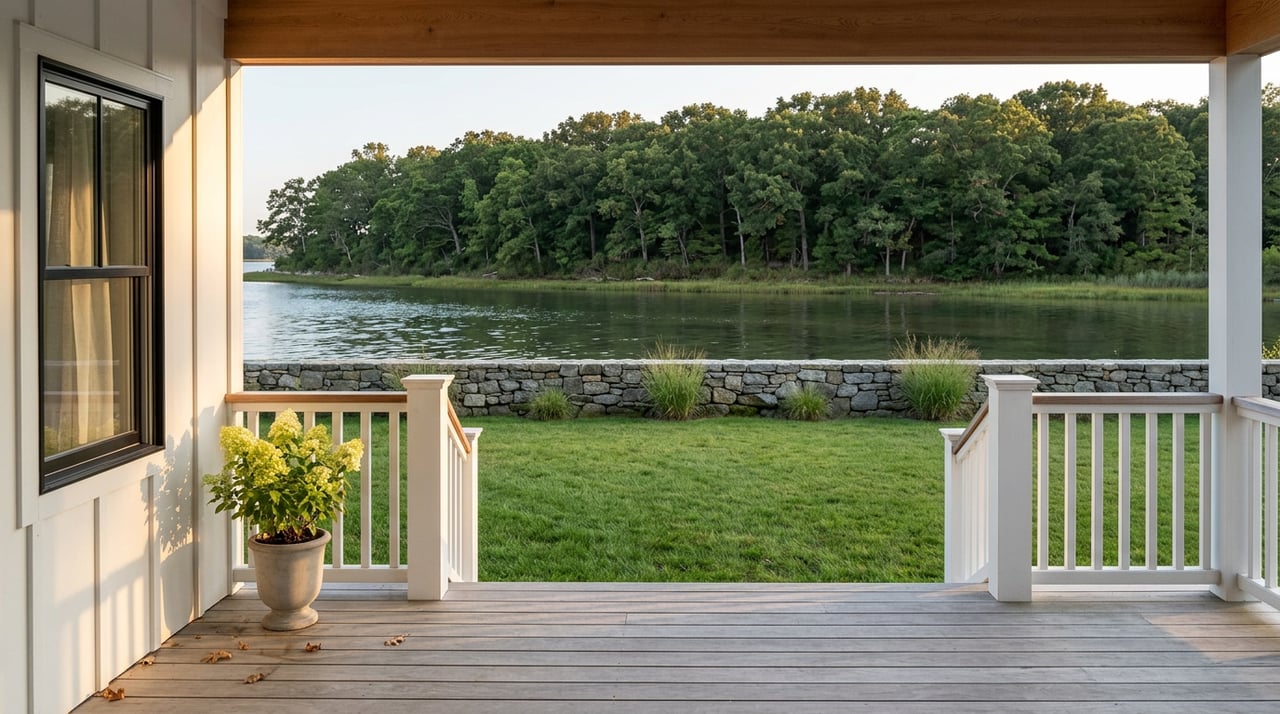
On White Lake, Every Seawall Permit Needs Two Governments to Agree
September 10, 2026
September 10, 2026
This past summer, the Michigan Department of Environment, Great Lakes, and Energy posted a public notice for a steel sheet pile seawall going in along White Lake in White River Township, with a comment period that ran through August 12, 2026. The notice said the project needed a Department of the Army permit from the U.S. Army Corps of Engineers, Detroit District, and that EGLE was separately reviewing the same seawall to confirm it met Michigan's water quality standards under the Clean Water Act.
Two governments. One seawall. That is not a paperwork quirk specific to one property owner on Indian Point Road. It is how shoreline construction works on this particular lake, and it is the detail that trips up buyers who assume a White Lake dock or seawall permit works the same way it would on a landlocked lake twenty minutes inland.
White Lake did not start as a lake you could sail a boat out of and straight into Lake Michigan. Lumbermen in the 1860s cut and maintained a channel by hand to move rafted timber out to open water, and in 1866 Congress funded a real harbor improvement. By 1868 the channel was cut and revetted on both sides, piers were extended out into Lake Michigan over the following years, a lighthouse went up along the channel in 1875, and the Army Corps has maintained the harbor with periodic dredging ever since. The navigation structures at White Lake Harbor, the piers and revetments that still hold that channel open, were listed on the National Register of Historic Places in 2000.
That history matters for a very practical reason. A lake with a direct, federally maintained connection to one of the Great Lakes is treated differently than a lake with no such connection. On a landlocked inland lake, a small seasonal dock for single-family recreational use is often exempt from a state permit entirely, and Army Corps jurisdiction rarely enters the conversation. On White Lake, work that touches shoreline near that channel corridor, like the seawall in White River Township, can pull in the Army Corps under federal navigable waters authority at the same time EGLE reviews it under state water quality rules. You are not filing one application. You are satisfying two agencies that do not answer to each other.
If you are buying a property with an existing dock or seawall, the question is not just "does it look sound." It is whether the structure was permitted at all, whether that permit is current, and whether it transfers to a new owner or requires you to reapply from scratch. If you are the one planning to build, budget the time for both reviews, not one.
The permitting layer above the water gets more tangled once you look at who governs the land itself. The City of Montague, Montague Township, and Whitehall Township share a single joint operation, the White Lake Area Building Inspection Department, with Whitehall Township having joined that arrangement as of January 1, 2018. The City of Whitehall runs its own separate building department.
In practice, that means the office you call for a zoning or building permit depends on which side of the lake your parcel sits on, and whether you are inside city limits or township land. A buyer who assumes "the city handles it" for a property that actually falls under Montague Township, or vice versa, can lose real time chasing the wrong office during an already tight closing window.
Ask three different sources for the median home price around White Lake this year and you will get three different answers, and the gap between them is the point, not an error. Across the 49461 zip code, which covers Whitehall and the surrounding townships, homes sold in the three months ending June 2026 carried a median sale price of $350,000, up 5.3 percent from the same period a year earlier, with homes typically spending 13 days on market compared to 11 days the year before. Narrow the same zip code down to the City of Whitehall specifically, and the April 2026 median sale price was $304,843, up 22.0 percent year over year. Zoom out to list prices rather than sold prices, and the zip code's homes were listed at a median of $439,000 to $449,000 in May 2026, spending closer to 47 to 52 days on market.
None of those numbers are wrong. They are measuring different slices of the same market: sold versus listed, city limits versus zip code, spring versus early summer. The wider picture is even more telling. Home prices across the zip code have ranged from $36,500 up to $1,599,000, and current listings in the area stretch from under $500,000 for an inland three-bedroom to well over $3 million for a home with more than 100 feet of direct lake frontage. A property with deeded or shared access to White Lake, a canal lot a few blocks off open water, and a direct-frontage estate with its own seawall are not competing in the same price tier, even though a portal search might show them all under "White Lake homes for sale." If you are shopping by headline median price alone, you are shopping the wrong number for the specific parcel type you actually want.
| Source and window | Geography | Metric | Figure |
|---|---|---|---|
| Redfin, 3 mo. ending June 2026 | 49461 zip code | Median sale price | $350,000 |
| Redfin, April 2026 | City of Whitehall | Median sale price | $304,843 |
| Movoto, May 2026 | 49461 zip code | Median list price | $439,000 to $449,000 |
| Realtytrac, 2026 snapshot | 49461 zip code | Price range | $36,500 to $1,599,000 |
White Lake carries an industrial memory that predates any of these numbers. Chemical manufacturing and the former Whitehall Leather Company tannery left contaminated sediment in the lake through much of the 20th century, and by 1985 White Lake was labeled a toxic hotspot and listed as a federal Great Lakes Area of Concern. The tannery closed in 2000. A second round of sediment removal in Tannery Bay took place in September and October of 2013, and White Lake was officially delisted as a federal Area of Concern in 2014, following two decades of work by the White Lake Public Advisory Council alongside local, state, and federal partners.
Today, a new residential shoreline community on White Lake carries that same name, Tannery Bay. A buyer looking at homes there today is standing on ground whose history was directly tied to the reason the lake needed a federal cleanup designation in the first place. The lake is clean and the designation is gone, but that history can still surface in a title search or in a straightforward conversation about what used to sit on a given stretch of shoreline. It is worth asking, not because anything is currently wrong, but because you want to know the answer before you are the one explaining it to a future buyer.
If the property you are buying or selling is not tied into municipal sewer, the agency you need is Muskegon County Public Health, which administers septic permits and evaluations for the area, not a regional health district and not the city building office. Some shoreline townships around White Lake have historically relied on individual septic systems rather than full sewer buildout, which means a septic evaluation can become a real factor in your closing timeline, particularly if the system's records are incomplete or the last pump-out is undocumented. Building that evaluation into your schedule early avoids a last-minute scramble the week before closing.
A few questions are worth asking on any White Lake waterfront property, regardless of price point:
Does every dock on White Lake need a federal permit? Not necessarily. Seasonal, removable docks built for single-family recreational use are often exempt from a state permit on ordinary inland lakes. White Lake's direct channel connection to Lake Michigan means permanent structures, and any work near that channel corridor, are more likely to draw in the Army Corps alongside EGLE review, so the safest move is to check before you build or buy rather than assume the same rules apply.
Is White Lake still affected by its industrial past? The federal Area of Concern designation was lifted in 2014 after the Tannery Bay sediment cleanup was completed. The lake is not currently flagged for contamination, but the history is documented and can appear in title research, so it is a fair question to raise during due diligence.
Who handles septic evaluation for a home not on sewer? Muskegon County Public Health, not a regional health district and not either city's building office. Confirm this early if the property in question relies on an individual system.
White Lake rewards buyers and sellers who ask specific questions instead of trusting a single headline number or a general waterfront checklist. If you are weighing a property in Whitehall or Montague and want someone who already knows which office to call and which questions actually matter for this shoreline, Gabriela Peterson offers marketing-first, neighborhood-specific guidance for buyers and sellers across Oceana County and the surrounding lakeshore towns, in English and Spanish. Schedule your free consultation and get answers built for this lake, not a generic one.




Gaby brings dedication, expertise, and a personal touch to every step of the process. With deep knowledge of the market and a passion for helping clients succeed, Gaby ensures your real estate journey is smooth, transparent, and stress-free.