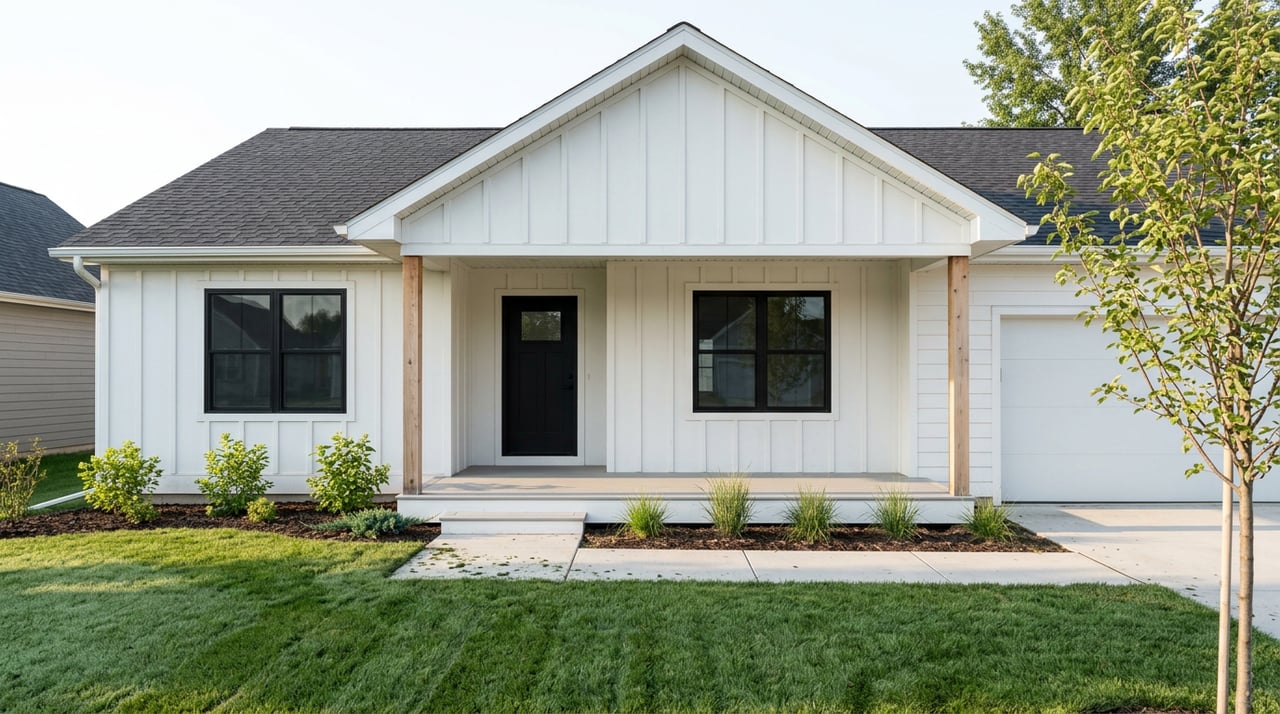
You Can't Outbid Your Way Into Shelby Acres
September 3, 2026
September 3, 2026
Say you find a listing for a home in Shelby Acres. Maybe it's the Maple, the single-level ranch with the open kitchen that's become the community's most requested model since it launched. You love the floor plan. You're pre-approved. You're ready to offer over asking to make sure you get it.
None of that guarantees you the house.
Shelby Acres, the 59-acre development going up on the north side of the Village of Shelby, doesn't sell homes the way the rest of the resale market around it does. There's no bidding war to win. Whoever submits first, or highest, doesn't get priority. Instead, buyers go through a workshop, get pre-approved, and then wait for a blind lottery to decide who gets a lot. If that sounds like an unusual amount of process for a house in a county where the median home still sells for well under $250,000, that's because it is, and it's unusual on purpose.
Before anyone can even submit a written offer on a Shelby Acres home, they have to attend an approved buyer workshop. The sessions cover three things: reading a credit report and understanding your score, building a monthly spending and savings plan, and the basics of buying a home. Only after completing the workshop and getting a mortgage pre-approval does a buyer become eligible to move forward.
This isn't a formality tacked onto the transaction. It's the entry requirement. Buyers who skip it don't get to enter the next step, no matter how strong their financing looks on paper.
Here's where Shelby Acres breaks from how nearly every other new construction sale works. At the start of each phase, a blind lottery decides who gets to buy which home. The drawings happen in person, at 7 PM, at the actual model home up for grabs. Phase 2's lottery for the Aspen model, for example, was held at the model home itself on Stonecrest Drive, with pre-qualified buyers or their agents present to learn whether they'd been selected.
The project's own materials are direct about why. Shelby Acres describes its position this way: "being the first to submit an offer or having the highest offer will not guarantee acceptance." In a typical market, speed and price are the two levers a buyer can pull. Here, neither one moves the needle until the lottery has run.
Once the lottery is complete for a given phase, whatever lots weren't selected go back on the open market on a first-come basis. That's the one point in the process where being first actually helps.
Shelby Acres is being developed by the Oceana County Development Corporation, a nonprofit founded by Linda and Earl Peterson, longtime Oceana County residents who also founded Peterson Farms and Oceana County Freezer Storage. Their reasoning for the lottery system ties directly to what happens in a tight housing market when supply falls short of demand. When there aren't enough homes to go around, buyers with more cash or faster financing tend to win, and prices climb past what many local workers can afford. A blind lottery removes that lever entirely. It doesn't matter how much you're willing to offer above the builder's price, because there's no bidding to do.
That's a meaningfully different approach than what's happening elsewhere in Shelby's resale market. Homes across the village have been selling for a median of roughly $224,000 to $230,000 as of May 2026, with typical time on market running around 74 to 79 days, longer than the national average of 52 to 58 days. Those numbers tell a specific story: prices in Shelby are still comparatively accessible for Oceana County, but resale inventory isn't moving quickly on its own. A nonprofit trying to solve a documented housing shortage in that kind of market can't just build homes and hope the usual rules of supply and demand sort things out fairly. The lottery is the mechanism that does the sorting instead.
It's worth separating two different numbers that get conflated when people talk about Shelby Acres. One is the resale market's median price, which reflects what a random assortment of existing homes across the village have sold for. The other is what Shelby Acres is actually solving for. When the project was first announced, Gaby Peterson, who sits on OCDC's board and serves as the development's listing agent, pointed to a local housing shortage estimated at around 40 percent of demand as the reason the project existed at all. A median price tells you what things cost. It doesn't tell you whether there are enough of them to go around. Shelby Acres exists because the second number was the real problem, not the first.
That distinction also explains a misconception that circulated when the project was announced: that these were subsidized or income-restricted homes. They aren't. Financing works through standard channels, including FHA, VA, USDA Rural Development, and conventional loans. The project did receive infrastructure support through a MEDC grant and a MARD grant from the State of Michigan, but those dollars went toward water, sewer, and road infrastructure, not toward discounting the homes themselves.
Across its four phases, Shelby Acres has introduced five model homes: the Aspen, Elm, Maple, Tamarack, and Chestnut. Two of them have enough detail worth knowing if you're comparing floor plans.
The Maple is a single-level, 3-bedroom, 2-bath ranch just under 1,200 square feet, introduced in Phase 2 and described by the development as its most requested model. The Chestnut is a newer addition, a 2-bedroom, 2-bath layout with just over 1,200 square feet entirely on the main floor, including a primary suite with its own bath, main-floor laundry, quartz countertops, and vinyl plank flooring, with a plumbed but unfinished basement ready for future expansion. The Elm has appeared in listings as a 2-bedroom main floor plan with a finished lower level adding an additional bedroom, bathroom, and laundry space.
Every home in the development connects to Village of Shelby water and sewer, plus underground electric, internet, and natural gas. Lots come with paved driveways and seeded lawns as part of the base build.
Shelby State Bank is the preferred lender for Shelby Acres buyers, with a dedicated loan officer, Deana Fox, assigned specifically to walk applicants through financing. Down payment assistance is available to buyers who meet the requirements, on top of the standard loan programs already mentioned.
Homeowners also pay association dues of roughly $30 a month, which cover maintenance of the development's retaining ponds, a planned playground, and other common grounds. It's a modest number, but it's worth knowing going in, since it applies regardless of which model or phase a buyer ends up in.
The full build-out calls for four phases of 21 lots each, roughly 82 to 84 homes total, making Shelby Acres the largest single housing project in Oceana County's history. The site sits directly across from the new Shelby Elementary School, which matters for buyers weighing school proximity alongside everything else.
As of the Village of Shelby's most recent published development update, Phase 3 was under construction. Lottery dates for each new phase get announced through the development's own channels rather than on a fixed public calendar, so anyone serious about getting into a future phase should plan to check in directly rather than assume a listing will simply appear when they're ready to buy.
Is Shelby Acres income-restricted or subsidized housing? No. The homes are financed through standard mortgage products. Grant funding covered a portion of infrastructure costs like water and sewer lines, not the price of the homes.
What happens if I'm not selected in the lottery? Any lots not claimed during the blind lottery are listed on the open market and sold first-come, first-served.
Can I skip the buyer workshop if I already have financing lined up? No. The workshop is a required step in the Sale Selection and Approval Procedures regardless of how strong your pre-approval looks.
If you're weighing whether a Shelby Acres lot makes sense against what else is available in Oceana County right now, that's exactly the kind of comparison worth working through with someone who knows both sides of it. Gaby Peterson can walk you through where the current phase stands, what's likely to open next, and how it stacks up against the resale options nearby. Schedule your free consultation to get a clear read on your options before the next lottery date gets announced.
Gaby brings dedication, expertise, and a personal touch to every step of the process. With deep knowledge of the market and a passion for helping clients succeed, Gaby ensures your real estate journey is smooth, transparent, and stress-free.